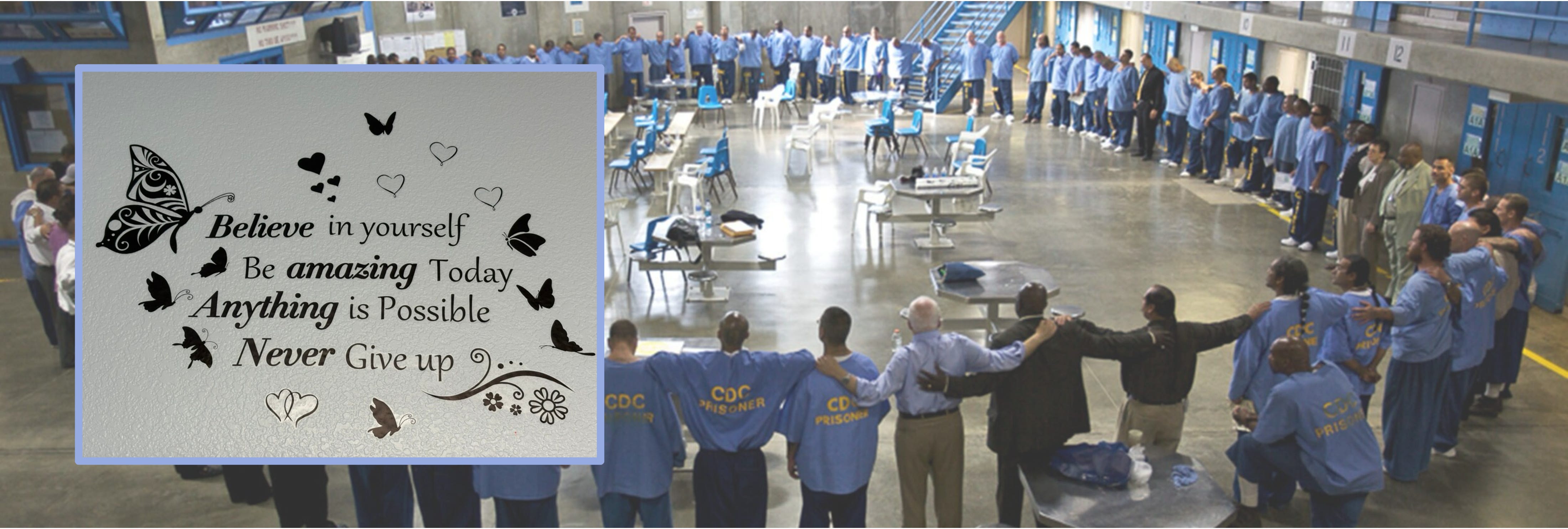
Our brains cannot experience stress, anxiety, or even depression, when we are in a state of gratitude - even from inside a maximum-security prison. That is where I found myself, and gratitude is exactly what I was feeling as I read the words posted over the door:
“Believe in yourself. Be amazing today. Anything is possible. Never give up.”
Someone had gone to some trouble to put them there as each statement was artfully positioned and pasted, surrounded by flowers, hearts, and butterflies. I literally stopped in my tracks at such an unusual sight amidst the sterile and controlled atmosphere of Salinas Valley State Prison. And I thought about gratitude.
Ending Up Here
I first stepped foot into a prison about 2013 and the first question people typically ask me is “why?” The simple answer is that a dear and trusted friend invited me and encouraged me to go on faith. Matthew 25 says, “What you have done for the least of my brothers and sisters, you have done for me,” and goes on to specify, “I was in prison and you came to visit me.” Yes, I quoted the Bible, but just for context. My more honest answer? I went out of a kind of morbid curiosity, not unlike slowing down at the sight of an accident on the highway.
Men I Didn’t Expect
I assumed I’d meet intimidating men defined by bad choices. And yes, some of them were intimidating. And yes, many bad choices had been made. But what I didn’t expect was how often those “choices” were really the only options available. Many of the men I met had never had what most of us would recognize as parents or role models, so they turned to gangs for “security” – hardly a choice as much as a perceived requirement for survival. For many of them, the choice which brought them to prison, many for life sentences, could be considered the better choice than the alternatives. Like quicksand or a lobster trap, once you’re born into that life, few escape. Built to hold 2,500, Salinas Valley currently houses nearly 3,000 men.
“There But for the Grace of God…”
The saying, “There but for the grace of God go I” is attributed to both St. Francis of Assisi as well as John Bradford, witnessing a group of prisoners being led to execution. I have struggled with that commonly used quote as it implies to me that God chooses to show his grace to some but not others. Yet, it rings true for me when I come here to be with these men, to engage in conversation, to play music, to share meals, to give hugs, and to reflect on the fact that if not for being born into privilege, I could be one of the 3,000.
“Cheerfully Flexible”
This day, I wasn’t at the prison to venture through the six locked doors and gates to visit the inmates. I was there to renew my “brown card” – the clearance needed to enter the prison. It requires reams of paper to be completed, a TB test, fingerprinting, and finally a picture. Today was the final step – my picture. The process can take weeks or months and because of this, and the untold, unanticipated, and unexplained delays, interruptions, changes, and cancellations of our visits, we have adopted the mantra to be “cheerfully flexible.” I have found this mantra helpful in all aspects of my life, and it is honestly easy to live by … if I remain grateful. That is the not-so-hidden, and perhaps even selfish benefit of my visits. They remind me to be grateful.
I drove 70 minutes to Salinas to take a single picture. My last brown card was good for 12 months, and then I start the process over again.
But I am grateful.
Grateful to have a car to drive the 70 minutes.
Grateful that I can afford to put gas in my tank.
Grateful for the ability to pick up a cup of coffee and snack on my way.
Grateful for a healthy mind and body that can make the trip.
I make it a point to try to be grateful for as many aspects of my life as possible. That is why I stopped to look at the quotes and hearts and butterflies over the doorway in the administration office of the prison. I thought about who might have put them there, how many people pause to appreciate them, and how many walk on by without even noticing they are there.
Gratitude Behind the Six Locked Doors
When I facilitate conversations with the inmates or the “men in blue” named after the blue scrubs they wear, we frequently talk about gratitude. I ask them what they are grateful for. Consistently and without hesitation, they jump in with:
“I am grateful I woke up this morning to see another day.”
“I am grateful for my kids, my children, my angels.”
“I am grateful for my spouse, my partner, my baby, my girl.”
“I am grateful for my “celly” (my cellmate).
“I am grateful that God is looking out for me.”
When I ask someone outside the prison walls, I typically encounter a pause. People ask for clarification. They search for a “worthy” answer to my question. Ultimately, they land on many of the same answers I hear from the “men in blue.” But it takes longer for us to get there.
Privilege’s Impact on Gratitude
I wonder if having so much makes it harder to appreciate what we have. Losing freedom, losing privilege seems to sharpen our vision. Matthew 19:23 says, “It is easier for a camel to go through the eye of a needle, than for a rich man to enter the kingdom of God.” Put aside the idea of heaven for a moment and consider how our freedom, our blessings, our privilege, our “first world challenges,” our abundance, can sometimes make gratitude more elusive.
A Broken Machine, a 5-Year Blessing
Back at the Prison Personnel Office, the clerk looks confused when I say that I am there to have my picture taken for my Brown Card. I called two hours earlier to make sure they had my paperwork and were ready for me, but I remain cheerfully flexible. He clicks the keys of his keyboard and looks at his computer screen.
“Is there any chance you can come back tomorrow?”
Swallowing my frustration in my bid to be cheerfully flexible, I reply, “I drove a long way to get here and called before I left. Can you share what the problem is?”
“Our machine which takes the pictures isn’t working – hasn’t been for a few days.”
In my last attempt to avoid another 2+ hour roundtrip, “anything creative we can do?” Long pause. Finally he turns his head and asks, “do you care if we use the picture from your last card?”
My heart lifted. “No, not at all!”
More keyboard keys clicking. He gives me a couple of pages to fill out and sign and slides his chair over to a machine off to his right. As I complete my task, I hear the machine start to hum. When he comes back to the counter, I hand him the signed pages, and he hands me my new brown card.
“Would you please confirm the information is accurate?”
Name - yes.
Height, weight, hair, birthdate - yes.
Expiration – 2030…5 years! Not 12 months but 5 years!
And once again, I am grateful.
The Science of Gratitude
It was later that same evening during a Thrive Global workshop as part of my certification to be a coach and facilitator, we discussed, of all things, gratitude. One statement brought me back to my experience earlier in the day:
“When you are in a state of gratitude, your brain cannot simultaneously experience stress, anxiety, or even depression.”
Nice to have science validate what was already clear.
Feeling Gratitude or Taking for Granted?
Gratitude isn’t reserved for quiet moments or prison chapels. It can happen in traffic, in processing delays, in broken machines and long drives.
I leave this with you for consideration:
Who—or what—might you be taking for granted today, that actually deserves your deepest gratitude?
Well that’s one helluva a way to introduce your writing on Substack Jeff!
Lands very close to my heart. Keep preaching it my friend!
Thanks for writing this. My take (slightly different angle) is I think when life is working for you, it’s easy to stay on autopilot, believing everything is fine because it feels fine. You’re just wearing pink glasses. Struggle breaks that illusion. Step outside the system and you start seeing the cracks; you realize your well-being was just insulation, not evidence of a healthy world.